Best AI Documentation for School Wellbeing Teams in Australia (2026 Guide)
Published 8 min read
Comparing AI documentation tools for Australian school counsellors, psychologists, wellbeing officers, and student support teams. Mandatory reporting, NCCD evidence, and privacy compliance compared.
- Education
- School Counsellors
- School Psychologists
- Wellbeing Officers
- Teachers
On this page
Summary
School wellbeing teams — counsellors, psychologists, wellbeing officers, and student support coordinators — face documentation requirements unlike any other professional setting. Mandatory reporting obligations, NCCD evidence collection, multi-disciplinary case management, and state-specific education privacy frameworks create a unique combination of needs that most AI documentation tools simply were not designed to address.
Very few AI documentation platforms are built for schools. This guide evaluates what is available in 2026 and what school wellbeing teams should look for when choosing a documentation tool.
What Schools Need (Different from Clinical Practice)
Before comparing platforms, it is worth understanding why school wellbeing documentation is fundamentally different from clinical practice documentation. The differences go beyond templates — they affect how the entire system needs to be designed.
Mandatory Reporting Awareness
In every Australian state and territory, school staff have mandatory reporting obligations for child abuse and neglect. The specific requirements vary by jurisdiction (in Victoria, for example, all school staff are mandatory reporters under the Children, Youth and Families Act 2005), but the documentation implications are consistent: notes may become evidence in child protection proceedings.
This means school wellbeing documentation must be factual, objective, and contemporaneous. An AI documentation tool used in schools must not generate subjective clinical interpretations, speculative diagnoses, or language that could be challenged in a legal proceeding. The tool needs to support the practitioner in writing notes that document what was observed, what was said, and what actions were taken — nothing more, nothing less.
For a deeper look at child protection documentation, see our child protection documentation guide (Grounded Scribe site) ↗ and the general mandatory-reporting guide — which links forward to per-state pages for NSW, VIC, QLD, WA, NT, and ACT.
NCCD Evidence Collection
The Nationally Consistent Collection of Data on School Students with Disability (NCCD) is an annual data collection required of all Australian schools. It requires structured evidence of adjustments made for students with disability across four categories: physical, cognitive, social/emotional, and sensory.
Documentation for NCCD needs to be structured, categorised, and retrievable. A wellbeing team that cannot quickly produce evidence of the adjustments made for a particular student — and the rationale behind those adjustments — faces compliance problems. An AI documentation tool for schools should support NCCD category alignment in notes and reports.
For detailed guidance, see our NCCD evidence collection documentation guide.
Privacy Frameworks Beyond the APPs
School student data does not just fall under the Australian Privacy Principles. Each state has its own education department privacy framework that adds additional requirements:
- Victoria: Privacy and Data Protection Act 2014, plus the Department of Education's own PRIS (Privacy and Responsible Information Sharing) framework
- New South Wales: Privacy and Personal Information Protection Act 1998 (PPIPA)
- Queensland: Information Privacy Act 2009 (IPA)
- Western Australia: WA PRIS Act (commencing 1 July 2026)
- Other states and territories: Each has its own framework with varying requirements
Student data is treated more restrictively than adult health data in many of these jurisdictions. Schools cannot simply use any cloud-based tool and assume compliance — they need platforms that understand and accommodate these state-specific requirements.
Multi-Disciplinary Notes
School wellbeing teams are not solo practitioners. They typically involve counsellors, psychologists, social workers, welfare coordinators, year-level coordinators, and sometimes external practitioners working together on student support. Documentation needs to support case management across roles, with appropriate access controls so that not all staff see all records.
A platform designed for individual private practice — where one practitioner writes notes about their own clients — does not naturally accommodate this multi-user, multi-role workflow.
Parent and Carer Communication
School wellbeing teams regularly produce documentation for families: reports and letters to parents, referral letters to external providers, mandatory reporting documentation, and updates on student progress. The documentation tool needs to support these communication workflows, not just internal case notes.
Check your system's rules before using AI for anything that goes to families. Victorian government schools, for example, follow the Department of Education's Generative Artificial Intelligence policy (page updated 28 September 2026), which says staff must not use generative AI tools to directly communicate with parents or write student reports for parents or carers, and requires opt-in parent and carer consent before using AI tools that need personal information.
What is Available in 2026?
The honest answer is that very few AI documentation tools are designed for school wellbeing teams. Most AI scribes target clinical settings — GP clinics, psychology practices, allied health — and assume a one-practitioner-one-client model. Schools operate differently.
Descant — An AI Platform with Dedicated School Features
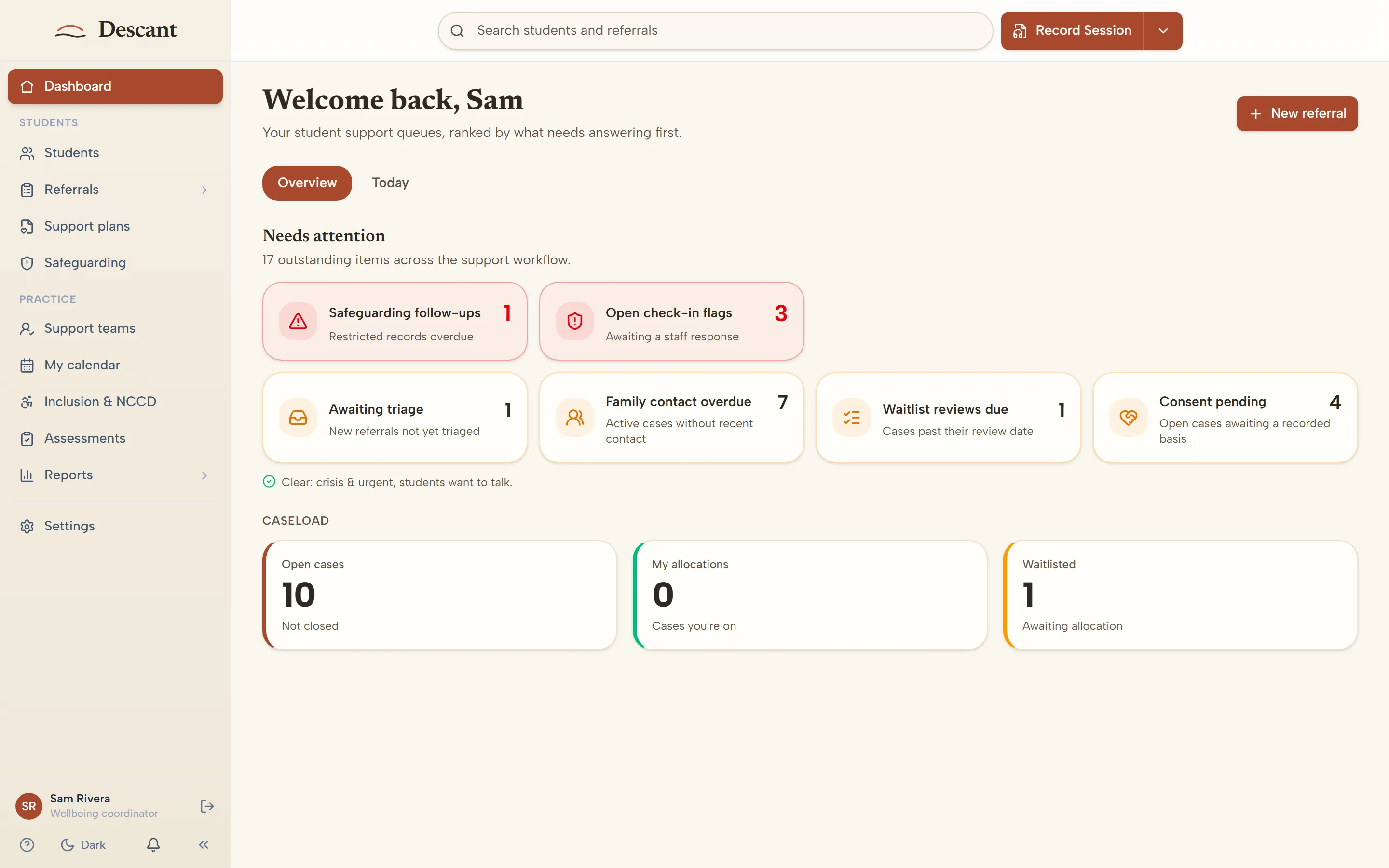
Descant is a student support platform for Australian schools, with AI-assisted notes for Australian schools. This is not a clinical tool repackaged for schools — it includes features specifically designed for Australian school contexts.
School-Specific Features:
- Student support platform with referral management, triage, case notes, support plans, mandatory report records, and multi-disciplinary case management. See our detailed walkthrough of the student support platform.
- Wellbeing check-ins through a secure link students open themselves. Check-ins that need attention are flagged by simple rules (for example, a student asking to talk, or rating mood or safety low) and wait in a queue for staff. No AI decides which students are flagged.
- "Wants to talk" queue so a student who has asked to speak to someone waits in a visible queue for the wellbeing team.
- Support plans using your state's plan type (IEP, PLSP, ICP, NEP and others), with goals, term-by-term progress, reasonable adjustments and review sign-off.
- NCCD evidence collection with a deliberate check: a note becomes evidence when the case lead nominates it and, where the school has a line manager, the line manager approves it. Each case can produce an NCCD evidence pack as a PDF.
- Assessment tools sent to students or families by secure link from the student's record, or completed in person with a staff member (the DASS-Y and DASS-21 are completed in person only). Scored results are saved to the student's record, each student has a results trend chart, and a reviewed result can be linked to an NCCD adjustment.
- Note templates — 34 school templates covering wellbeing, learning support and NCCD, behaviour, meetings and families, plus templates your school creates itself.
- Session recording and AI transcription for school counsellor and psychologist sessions, with the same transcription used across the platform.
- Australian data storage — student records stored in Australia, with transcription and note drafting run here too, which matters for state education department privacy requirements.
School Pricing:
Descant offers a school-specific pricing model designed for multi-seat deployments:
| Component | Cost |
|---|---|
| School fee | From $99 a month (+GST), banded by enrolment |
| Per-seat AI Scribe (Plus) | $19/month per seat |
| Per-seat AI Scribe (Core) | $39/month per seat |
| Per-seat AI Scribe (Pro) | $69/month per seat |
| Per-seat AI Scribe (Max) | $99/month per seat |
Current Descant pricing and offer dates are published on the pricing page.
Optional School Scribe seat discounts: 5% for 5 to 10 seats, 10% for 11 or more.
For full details on school pricing, see our pricing page.
Best suited for: Schools wanting AI-powered documentation alongside student wellbeing case management, NCCD evidence support, and multi-disciplinary team workflows.
FocusCS — Counselling-Specific Software (No AI)
FocusCS is an Australian company that builds purpose-built software for school counsellors. It is specifically designed for the school counselling context, with features for session notes, referrals, and some reporting capabilities.
Strengths:
- Purpose-built for Australian school counselling
- Understands the school context and counsellor workflows
- Referral management and basic reporting
- Australian company with local support
Considerations:
- No AI transcription or automated documentation — all notes are written manually
- No assessment tools or validated screening instruments
- Limited multi-disciplinary support — primarily designed for counsellors rather than broader wellbeing teams
- Currently on its third major rebuild, which may affect stability and feature completeness
- No wellbeing check-in system or "wants to talk" queue
- Pricing is not publicly transparent
FocusCS is a reasonable choice for schools that want a basic digital case management system specifically for school counsellors and do not need AI documentation capabilities. It does not attempt to be an AI tool, and it does not pretend to serve the broader wellbeing team.
Best suited for: Schools wanting a simple, counselling-focused digital record system without AI features.
General AI Scribes (Heidi, Freed, Upheal, etc.)
General-purpose AI scribes like Heidi (Grounded Scribe site) ↗, Freed (Grounded Scribe site) ↗, and Upheal (Grounded Scribe site) ↗ are built for clinical settings — GP clinics, psychology practices, allied health consulting rooms. They do a good job in those contexts.
However, they miss virtually all of the school-specific requirements:
- No mandatory reporting awareness — notes may contain language inappropriate for child protection proceedings
- No NCCD evidence support — no structured categorisation of student adjustments
- No state-specific education privacy framework compliance — designed for health privacy, not education privacy
- No case management — one-practitioner-one-client model, not multi-disciplinary team workflows
- No student wellbeing features — no check-ins, no "wants to talk" queue, no support plans
- No school pricing model — individual practitioner pricing that becomes expensive across a team
A school psychologist doing individual therapy sessions could theoretically use any clinical AI scribe for the therapy transcription component. But that only covers one small part of what school wellbeing teams actually document.
Best suited for: Individual school psychologists or counsellors who only need AI transcription for one-on-one therapy sessions and are comfortable managing all other school documentation separately.
Head-to-Head Comparison
| Feature | Descant | FocusCS | Generic AI Scribes |
|---|---|---|---|
| AI transcription | Yes | No | Yes |
| AI note generation | Yes | No | Yes |
| NCCD evidence support | Yes | Limited | No |
| Mandatory report records | Yes | Some | No |
| Wellbeing check-ins | Yes (secure link, rule-based flags) | No | No |
| Referral management | Yes | Yes | No |
| Multi-disciplinary case management | Yes | Limited (counsellors) | No |
| Assessment tools | Yes (validated instruments) | No | No |
| Support plans (IEP and state equivalents) | Yes | Not stated | No |
| "Wants to talk" queue | Yes | No | No |
| Family contact log | Yes (contacts logged, not sent) | Limited | No |
| School pricing model | Yes (from $99 a month, banded by enrolment, + optional seats) | Contact for pricing | Per-practitioner |
| Australian data storage | Yes | Yes | Varies |
What to Look For When Choosing
If you are evaluating documentation tools for your school, here are the key questions to ask:
State-specific compliance: Does the platform understand your state's education privacy framework? Victoria, NSW, Queensland, WA, and other jurisdictions each have different requirements. A tool that only addresses the Australian Privacy Principles is not sufficient for schools.
Role-based access control: Can you restrict what different staff members see? Not all records should be visible to all team members. A year-level coordinator should not necessarily see the same case notes as the school psychologist.
Student-level data separation: Is student data kept separate from other clinical or health data on the platform? Schools need assurance that student records are not commingled with adult health records.
Family contact records: Can you record every contact with a family — calls, emails, meetings — on the student's record, so the team knows when the family was last spoken to? School wellbeing teams spend significant time on parent communication — the record of it should be supported, not an afterthought.
External referral tracking: When you refer a student to an external provider (paediatrician, child psychologist, occupational therapist), can you track the referral status and outcomes within the system?
Pricing transparency: Does the platform offer clear school pricing, or do you need to contact sales and negotiate? Transparent pricing allows schools to budget accurately.
Our Recommendation
For school wellbeing teams wanting AI-powered documentation alongside genuine school-specific features, Descant is purpose-built for Australian schools, combining AI transcription, student support case management, wellbeing check-ins, NCCD evidence collection, and multi-disciplinary team workflows in one platform.
For schools wanting basic digital case management without AI capabilities, FocusCS is an alternative specifically designed for school counsellors — though it lacks the breadth to serve an entire wellbeing team.
For school psychologists doing individual therapy sessions, any clinical AI scribe works for the therapy transcription component. But it will not handle the broader school wellbeing documentation needs — mandatory reporting, NCCD evidence, wellbeing check-ins, and multi-disciplinary case management.
The reality in 2026 is that the market for school-specific AI documentation is still emerging. Most AI scribe companies are focused on clinical practice, and schools have been an afterthought. That is changing, but slowly.
Disclaimer: Pricing is based on publicly available information as of March 2026. Visit each provider's website for current rates. All prices are in AUD and exclude GST unless otherwise noted.