IEP Tracking for Australian Schools — NCCD-Aligned, Built for Wellbeing Teams
Published 8 min read
Track Individual Education Plans with NCCD-aligned categories, state-specific plan types, SMART goals with term-based progress, reasonable adjustments, review sign-off and NCCD evidence pack PDFs — all inside the same platform where your wellbeing team already manages referrals and case notes.
- School Counsellors
- School Psychologists
- Teachers
- Wellbeing Officers
- Education
On this page
- The Problem with Current IEP Workflows
- NCCD Alignment Built In
- State-Specific Plan Types
- SMART Goals with Term-Based Progress
- Reasonable Adjustments by Category
- Review Workflow with Contributors
- PDF Export: NCCD Evidence Pack and Handover PDFs
- Sharing Plans with Families (No Parent Portal)
- Connected to Everything Else
- Getting Started
Summary
Descant includes support plans built for Australian schools. Create Individual Education Plans (or your state's equivalent) on the student's case, set learning goals and record progress each term, document reasonable adjustments by category, and complete reviews with sign-off. Supporting notes become NCCD evidence when the case lead nominates them and, where your school has a line manager, the line manager approves. When you need it, produce an NCCD evidence pack or a student handover document as a PDF. Plans sit alongside the referrals, meetings and case notes your wellbeing team already manages.
The Problem with Current IEP Workflows
In most Australian schools, Individual Education Plans live in Word documents, shared drives, or purpose-built spreadsheets. The coordinator creates the document, emails it to teachers for input, prints it for the parent meeting, and then files it somewhere that may or may not be findable next term.
This creates several recurring problems:
- Version control — multiple copies of the same IEP with different edits, no clear record of which is current
- Progress tracking — goal progress is recorded inconsistently, often only at formal review points rather than throughout the term
- NCCD alignment — the connection between the IEP and NCCD reporting is maintained manually, often in a separate spreadsheet
- Evidence — the notes and observations that show an adjustment is happening are scattered across inboxes and personal files
- Handover — when a coordinator changes or a student moves schools, the IEP history is difficult to reconstruct
Support plans in Descant address these by keeping the plan as a living record inside the same platform where the wellbeing team already manages referrals, case notes, and student support.
NCCD Alignment Built In
NCCD asks schools to show the level of adjustment provided to each student with disability, under one of four categories, backed by evidence. Plans in Descant are built around the same language:
Disability categories:
- Physical
- Cognitive
- Sensory
- Social/Emotional
Adjustment levels:
- Quality Differentiated Teaching Practice (QDTP)
- Supplementary
- Substantial
- Extensive
The category and level are recorded by your team — Descant does not decide them.
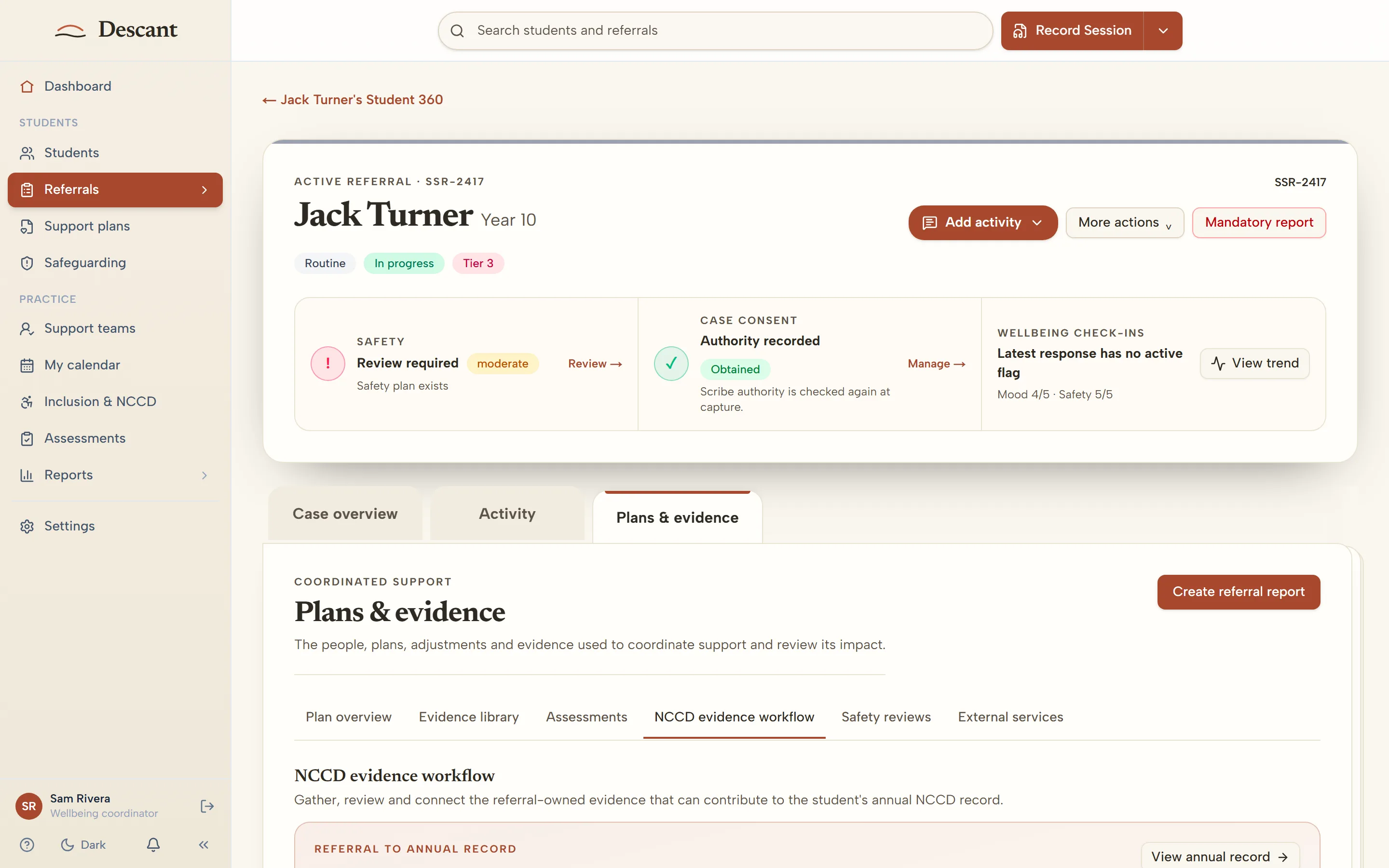
Evidence is handled deliberately. A case note does not become NCCD evidence just because it was written. The case lead nominates the note as evidence, and where your school has a line manager, the line manager approves it before it counts. This keeps the evidence base to the material your team has actually checked, rather than everything that happens to mention a student.
Notes released this way, and assessment results that have been reviewed and signed off, can be linked to adjustments on the student's annual NCCD record.
At reporting time, you can also produce an NCCD evidence pack for a student's case as a PDF. It draws together the case's finalised notes, family contacts, support plans, adjustments and reviews, so the record you bring to moderation reflects what was documented through the year.
State-Specific Plan Types
Australian states and territories use different names for what is functionally the same document. The system supports all common plan types:
- IEP — Individual Education Plan (most common nationally)
- ILP — Individual Learning Plan
- ICP — Individual Curriculum Plan
- NEP — Negotiated Education Plan (SA)
- PLSP — Personalised Learning and Support Plan (NSW)
- PLP — Personalised Learning Plan
- BSP — Behaviour Support Plan
- Health Plan — for students with medical conditions requiring school-based management
Staff choose the plan type when they create a plan, so you can use the name your state or sector already uses, and add another type where a student needs it — a Behaviour Support Plan or a Health Plan alongside a learning plan, for example.
SMART Goals with Term-Based Progress
Each plan contains one or more learning goals, written so they can be measured:
- Curriculum area — which learning area the goal addresses (e.g., English, mathematics, social skills, self-regulation)
- Baseline — where the student is now, expressed as a measurable starting point
- Target — where the student is expected to be by the review date
- Strategies — the teaching strategies and adjustments that support progress toward the goal
Progress is recorded term by term. Staff add progress entries with:
- A rating of how the student is tracking against the goal
- Comments explaining the rating and what has been observed
- Date of the progress entry
This creates a running record of goal progress that the coordinator and the staff working with the student can see on the case. It replaces the pattern of goals being set at the start of the year and only reviewed formally at the end, and it gives the team something concrete to bring to review meetings with families.
Reasonable Adjustments by Category
Adjustments are documented under structured categories:
- Curriculum — modifications to what is taught
- Instruction — modifications to how content is delivered
- Assessment — modifications to how learning is measured
- Physical environment — physical or sensory modifications to the learning space
- Social and emotional — supports for wellbeing and social participation
- Communication — supports for receptive and expressive communication
- Personal care — support with personal care needs during the school day
- Safety and supervision — supervision and safety arrangements
- Assistive technology — equipment or software that supports access to learning
- Other — any adjustment that does not fit the above categories
Each adjustment includes a description, so the record shows not just that an adjustment exists but what it involves in practice. Documenting adjustments consistently, in the same place as the goals they support, makes it easier to connect them to the NCCD level your team records.
Review Workflow with Contributors
Plans are reviewed on the cycle your school uses — a term review, a mid-term check, an annual review, a transition review, or an ad hoc review when something changes. Reviews and plans record:
- Review type and date
- Who contributed — the coordinator, teachers, specialists, the family and the student, as your process requires, listed as contributors on the plan
- Sign-off — staff contributors sign off for themselves, and a family's sign-off is recorded by staff as witnessed; a completed review shows when it was completed and by whom
- The meeting — you can hold the review as an IEP Review meeting, one of the six meeting types in Descant, with attendance and actions recorded
A review that is documented as a collaborative process, with the family and the people who work with the student visibly involved, is stronger evidence than a coordinator-authored update on its own.
PDF Export: NCCD Evidence Pack and Handover PDFs
Two documents that matter most for plans can be produced from a student's record as PDFs:
- NCCD evidence pack — the finalised notes, family contacts, plans, adjustments and reviews on the student's case, for NCCD verification and moderation
- Student handover — a summary for handing the student's support over to a new coordinator, a new campus or a new school
These are the documents schools most often need to assemble in a hurry — at census time, or when a student moves on. Producing them from the record means they reflect what was documented through the year, rather than what someone can remember.
Sharing Plans with Families (No Parent Portal)
Descant does not have a parent portal, and families do not log in to see plans. Plan progress is shared with families the way most schools already do it: at review meetings and in conversations with the coordinator.
What the platform adds is a record of that contact. When staff contact a family — a phone call, an email, a meeting — they log it on the student's record, so the team can see when the family was last spoken to and what was discussed. Descant logs these contacts; it does not send messages to parents.
Families can also raise a concern themselves. Parents and carers can make a referral through your school's secure referral link, which checks their email with a code before the referral reaches the team's review queue.
Connected to Everything Else
Plans do not exist in isolation. They connect to the broader student support workflows in the platform:
- The student's case — the plan sits on the case alongside referrals, meetings, check-ins and case notes, so the people supporting the student see the full picture.
- Meetings — plan reviews can be held as IEP Review meetings, so the agenda, attendance and action items are part of the same record.
- MTSS tiers — the student's support tier, and its history, sit on the same case as the plan.
- NCCD evidence — notes the case lead nominates and the line manager approves, and reviewed assessment results, can be linked to adjustments on the student's NCCD record through the year, reducing the work at reporting time.
Getting Started
Schools using Descant create plans from the student's case. Open the case, go to Plans & evidence, and create a new plan. You record the NCCD category and level, goals and adjustments in a structured form.
If your school is not yet using the Student Support Platform, visit For Schools to learn more or get in touch for a walkthrough.
Support plans are a documentation and coordination tool. They do not make educational or disability recommendations. All goals, adjustments, NCCD categories, levels and review outcomes are determined by the professionals and families involved in the student's support.